From Shoegaze Icons to Genre-Breaking Rebels: Why Primavera Sound 2026 Hit Different

The T4 tram rattles toward Parc del Fòrum. It is mid-afternoon, the Mediterranean sun is already punishing, yet the carriage is crammed wall-to-wall with people practically vibrating with urgency. A guy squeezed against the doors finally gives up on a patchy phone connection, shoving his mobile into his pocket before announcing loudly to the entire sweltering carriage: "They’re already queuing. There are three thousand people at the venue right now." We are all heading to the exact same place, rushing the gates for the festival’s opening act: Cameron Winter. The fact that thousands of people are willing to sprint across hot concrete for a solo artist recently captured on film by Paul Thomas Anderson tells you everything you need to know about the crowd this festival commands.

The European summer festival circuit is notoriously repetitive. By mid-July, the continent is blanketed in identical fields offering the exact same recycled roster of heritage acts and safe, radio-friendly pop. Primavera Sound consistently avoids this trap, and the 2026 edition in Barcelona underlined exactly why it remains a crucial fixture. The total liberalization of music distribution, combined with decentralized underground communities sharing tracks organically across social media, has completely broke the traditional gatekeepers. We are living in a post-genre era, and Primavera is one of those rare festival built to reflect it. Its curation relies on the radical assumption that the modern listener possesses an insatiable, expansive palate. There is no demographic segregation here. The same individual who spent Saturday night engulfed in the bruising, analog distortion of my bloody valentine can seamlessly transition into the hyperactive, glitch-pop landscape of Ninajirachi without an ounce of cognitive dissonance.
This omnivorous appetite draws a fiercely dedicated international crowd that treats the Parc del Fòrum as a holy site. On the concrete plazas between stages, I spoke with a group of friends who had mapped out a staggering journey all the way from South Korea with a hyper-specific itinerary: to catch Oklou’s fragile electronic pop on Thursday and Slowdive’s towering dream-pop on Friday. It is a testament to a generation that refuses to let corporate streaming recommendation loops dictate their musical horizons; instead, they travel across oceans to witness these subcultural crosscurrents collide in real-time.

For the obsessive listeners, the Auditori Rockdelux remains the festival's anchor. The indoor, air-conditioned theater is a meticulously curated space for the fringe and the avant-garde. Thursday saw the London-based outfit caroline extract absolute silence from the room with a fragile, scraping performance that felt like it could snap at any moment. Later, Lucrecia Dalt warped the same acoustics, manipulating analog synthesizers and her own vocal cords into bizarre, compelling shapes. The programming leaned heavily into experimental histories on Friday, bringing in vocal pioneer Joan La Barbara and the dizzying polyrhythms of Iranian percussionist Mohammad Reza Mortazavi. When These New Puritans took the theater stage on Saturday for their Primavera debut, Jack Barnett’s aggressively sharp orchestrations provided a harsh, deeply satisfying contrast to the outdoor chaos.
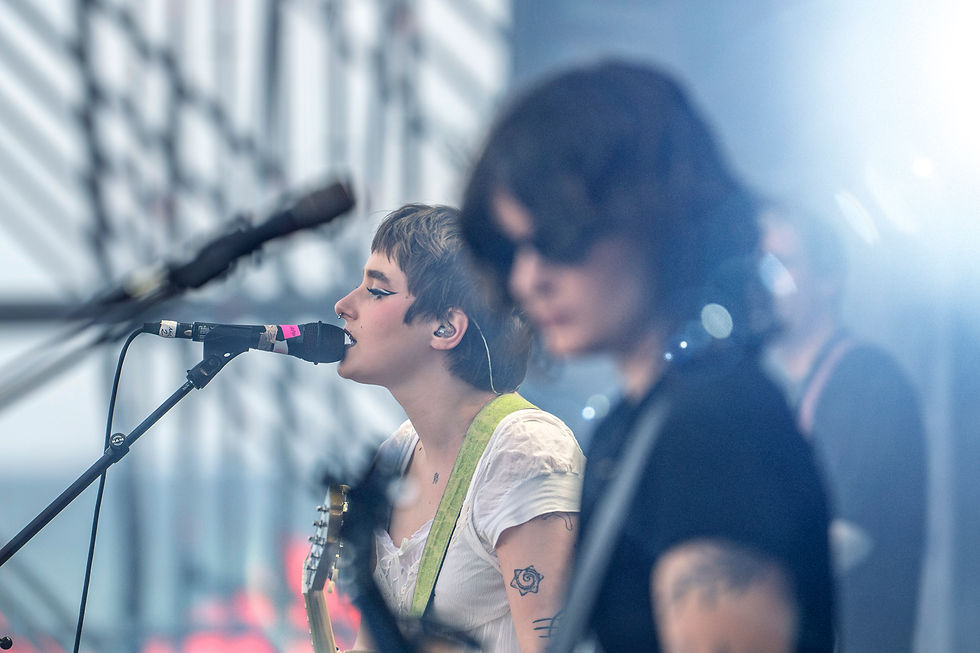
Out in the punishing sun, categorizations fell apart just as quickly. Ireland’s NewDad took a Friday afternoon slot and forcefully dismantled the lazy "shoegaze" descriptors attached to them. Instead of getting lost in pedalboards, they drove their set with thick, menacing basslines and a sneering post-punk attitude. Julie Dawson’s vocals cut right through the coastal breeze, completely devoid of pretension. Their absolute peak was a ferocious cover of the Yeah Yeah Yeahs’ "Heads Will Roll." They didn't slow it down; they rebuilt it into a guitar-heavy, post-punk juggernaut. For any millennial in the crowd who spent 2009 sweating to the original at indie sleaze parties, hearing it resurrected with this much sneering distortion was the best present imaginable.

Big Thief played Saturday with a terrifying, erratic intensity. Adrianne Lenker treats her catalog with total volatility, bending songs out of their studio shapes in real time. The set was wonderfully unstable. Tempos fluctuated, acoustic guitars drifted out of tune, and Lenker ripped through raw, jagged solos with her eyes clenched shut. Looking out across the massive outdoor plaza, the effect was immediate and profound. You could spot people throughout the crowd quietly wiping their eyes, totally leveled by the sheer, unvarnished vulnerability of the performance. They managed to strip tens of thousands of people of their festival exhaustion, replacing it with a heavy, deeply moving shared silence.
The Cure handled the Friday night closing duties with a mammoth two-and-a-half-hour set. Robert Smith’s voice retains the exact pristine, heartbroken wail he possessed in the 1980s. Defying the standard festival playbook, they refused to rely solely on the obvious hits. Smith and company dug deep into the corners of their discography, pulling out rarities like "2 Late”. It was a wildly generous set that treated an audience of eighty thousand like a small club crowd.
Following that, my bloody valentine delivered their set, and the crowd gathered in front of the stage was a fascinating sociological study. Up front stood people in their fifties—the former weirdo kids who championed a dense, alienating genre that few understood when the band first emerged. Right beside them were teenagers who had obviously discovered the back catalog through viral TikTok audios. This generational collision birthed something genuinely unprecedented. As the band launched into their signature wall of sound, a massive mosh pit of young men violently opened up in the center of the crowd. Back in the early nineties, shoegaze audiences were notoriously static, standing perfectly still while staring at their shoes. Today, throwing your body against strangers to the sound of Kevin Shields' guitar tone is the absolute coolest thing imaginable.
The band played opposite a completely unannounced surprise set from Olivia Rodrigo occurring on the other side of the festival, yet they showed zero interest in compromise. Right before walking offstage at the very end of the night, Shields surveyed the surviving audience, leaned into the mic, and muttered a deadpan, "Thanks for coming here instead of going to see Olivia Rodrigo."

Any expectation of quiet restraint from The xx vanished the moment they headlined later that evening. Romy Madley Croft and Oliver Sim traded their hushed studio vocals for a sharp, stadium-ready clarity, backed by Jamie xx's massive, club-heavy low end. They turned the vast concrete layout of the Fòrum into an open-air rave, backed by a crowd screaming every lyric back at them. Dropping "Intro" triggered absolute euphoria. The track became a generational touchstone, a distinctly millennial reverie bouncing off the water as eighty thousand people lost their minds to the opening notes.
By Sunday morning, nearly 290,000 people had passed through the gates. In an era where live music is increasingly packaged and sanitized, Primavera Sound remains an outlier. It operates on a stubborn, vital conviction that a festival can be more than just a logistical exercise or a hollow brand activation. By rejecting the safety of the mainstream and inviting the weird, the difficult, and the boundary-pushing into the spotlight, the weekend served as a reminder that the most potent experiences are those that resist easy classification. At a time when we are constantly told that algorithms know our tastes better than we do, Primavera thrives by trusting its audience to navigate the chaos, proving that when you give people a genuinely diverse space to collide, they will build a community that no corporate template could ever replicate.


Comments