"It's a very cannibalistic world, especially on the internet": Cam Smith on Ladder to God, Touring with Nothing, and Cancel Culture

I meet Cam Smith just before Nothing’s second sold-out show in Tokyo. While the world knows him as a vital member of the group, I’ve long been intrigued by his own project, Ladder to God. Within minutes, it's clear the intuition was right: Smith is a rare, singular talent.
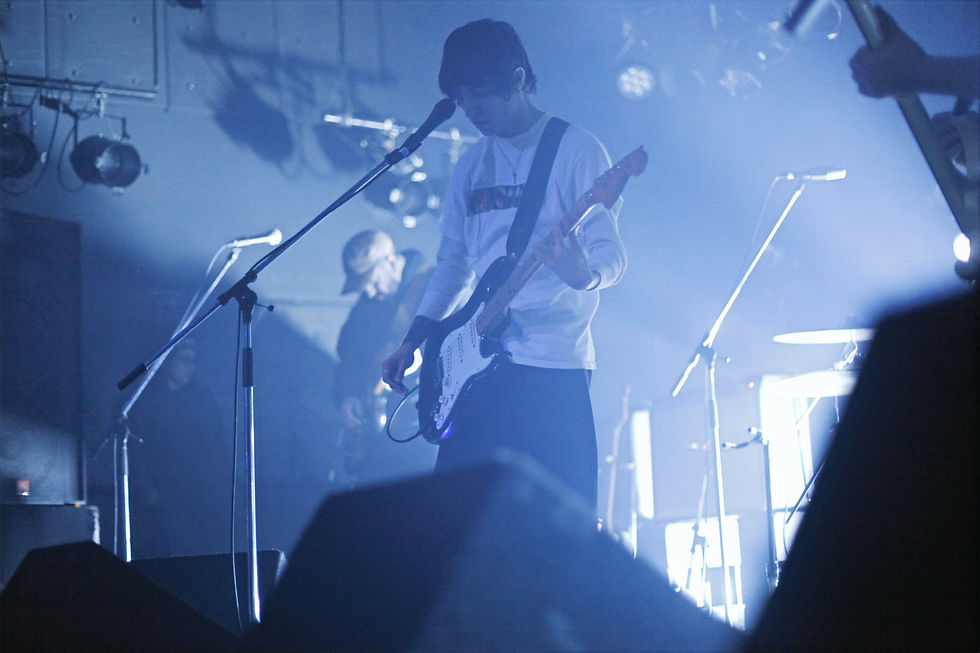
It’s almost hard to believe that back home in Alabama, Cam leads a remarkably quiet life. There, he works as a barista at a local café and hardly ever leaves his flat, spending his nights with his two cats sleeping beside him. But on stage, the transformation is total. During last night’s performance, he stole the show—an energy even Domenic Palermo acknowledged when he told me, “He’s hot, and he makes us look better on stage.”
Beyond the stage lights, however, Cam reveals himself to be strikingly well-read and deeply immersed in cinema. “I watch a lot of movies. Film is my favorite art form,” he tells me. When I ask if that’s true even more so than music, he doesn’t hesitate. “I think so. My favorite films have changed who I am and my life.” He is more likely to reference the existentialism of Albert Camus or the cinematic vastness of Terrence Malick than engage in typical gear talk. He speaks with a refreshingly clear sense of intention about the music he wants to create—music that pushes back against the TikTok-driven trends currently flooding the shoegaze scene.
Our conversation drifted far beyond music. We spoke at length about how art—whether books or films—can be life-changing. We discussed the weight of The Satanic Verses by Salman Rushdie, which led us to a shared history of shedding the skin of our upbringings. Cam opened up about his time in a “culty” evangelical megachurch and how leaving it made him appreciate the world more deeply. What was supposed to be a standard interview turned into a meaningful exchange, proving that Cam Smith is exactly what the modern scene needs: a musician who values the song over the noise.
“ I would rather be a very poor musician than a rich person that hates what they're doing.”
For those who aren't familiar with you yet, could you tell us a bit about your background and where you’re from?
I live in Birmingham, Alabama, in the south of the USA. I have lived there since I was seven. It's a small city, but we have a very tight-knit punk-hardcore scene. We don't have a lot of shoegaze, really. There are a couple of bands like fauxdeep, mood room, and Bitter Calm, but there's not a huge scene for it. I used to play guitar at a church when I was a kid. That's how my pedalboard became what it was, and the way that I play guitar is influenced by church music from when I was a kid that I'm no longer involved in. It was very influential to me.
You come from a metal and hardcore background. How did those heavy roots eventually lead you toward the shoegaze?
There are a lot of similar textures between metal, hardcore, and shoegaze. There’s a lot of very heavy shoegaze, including Nothing. I mean, it can be really great. I feel like there's a lot of it right now that maybe people who heard Deftones are doing; there's a lot of copy-and-paste stuff. I really enjoy the quieter side of it. Slowdive was the first shoegaze band that I found.
Was this your first time hearing shoegaze?
That I can remember. When they put out their self-titled album in 2017, I found it on Bandcamp. I had no idea who they were. It definitely opened my mind because I had already enjoyed music with similar tones from when I used to play Christian music—bands like Copeland and From Indian Lakes that aren't really shoegaze but have a lot of elements of that. But I was in the more hardcore metal scene, and I really like the live energy of hardcore shows. It's fun to find the middle ground between the two.
What kind of music did you listen to when you were growing up?
It was my dad. He didn't really get me into shoegaze, but he can play guitar way better than me. He can shred metal. He played metal growing up and was in Hollywood when he was 18. He can play the craziest guitar, and he showed me Lamb of God, Killswitch Engage, and just a bunch of metal as a very young kid. It opened my mind to alternative music for sure. As a kid, I didn't really understand it, and then when I was 13, 14, or 15, it started to make more sense to me.
What kind of music did kids listen to in school back then?
Top 40 pop. There’s some good pop music, but I knew it didn't do much for me. I don’t think you can truly know until you find something that affects you and changes the way you think about art. Music was always just music, and then you find something that is more than that—something that actually affects you. I don’t know what the first record I heard that did that was, but Slowdive's record definitely opened my mind and made me question what at least that genre of music was.
That's so interesting because so many people use Souvlaki as their entry point.
Yeah, Souvlaki and things like that. It's a great record. But my favorite is Pygmalion. It's underrated. "Rutti" and "Crazy for You" are the best opening tracks. They put you in another world. It's incredible.
Do you remember the moment when you realized that music was something you wanted to pursue as a professional?
When I was in high school, none of the people in my school were similar to me. I felt very out of place. All of the music I listened to was different from them and I didn't really have any friends. I would just go home and play music. I never thought I would play music professionally, but I knew even as a 16-year-old that I want to do music—whether it's photography, tour managing, or anything I can do. I knew I didn't want to be on a traditional path—graduate, go to college, work in an office. I knew I couldn't do it. I would rather be a very poor musician than a rich person that hates what they're doing.
Let’s talk about your own project. How did Ladder to God originally come together?
My best friend in Alabama, his name is also Cam. We were playing in a metal band together—a very heavy death metal band—and I was listening to a lot of non-heavy music and I wanted to do a rock band. We started a band called Just Like Heaven in 2019. That was the precursor before we became Ladder to God. It's more Catherine Wheel-ish, poppy, and I wouldn't call it shoegaze, to be honest. It's more like alternative rock trying to be pretty catchy. I still like those songs, but I was like, "I need to go further—sadder and slower." We didn't like the name either. We only have one EP. It was self-released and very under the radar; nobody knows about it. Then we did Ladder to God, which was the same band but just a different name.
And how did you come up with the name?
The band Swans. They have a song called "The Apostate," and one of the lyrics is "Ladder to God." We both like Swans.
Last year you released two songs that sounded totally different—it felt like you pushed your sound forward. Nick Bassett was involved too. Can you tell the story behind these two songs and why you decided to make them different?
Cam left the band two or three years ago. We really haven't done a whole lot. We did the first EP in 2021, and I started touring with Nothing in 2022. So my life became very busy and I had no time for Ladder to God. It was just a local band for us and low effort. Then he left and I wrote those two songs three years ago now. We just never got around to recording them or doing it right. About a year ago we recorded them, and it took so long to get them ready. They were sitting unreleased for a year after we recorded them. By the time we put them out, I messaged Brian from The Funeral Party and I was like, "Hey, I have these two songs. If you don't want to put them out, I'm just going to put them out. I'm sick of waiting." I still like the songs, but I'm way past it. I wrote both of those entirely, so that's probably why they sound a little different. Me and Cam used to collaborate, but on the new ones, I just did everything and I'm also the only one singing. On the first EP, we split the singing. So now Ladder to God is pretty much my thing—entirely my creative outlet. We just recorded three new songs, too. We're trying to do a full-length. Once I'm home from Japan and then a full US tour, we're going to try and record some more songs and do a full-length LP. The recording quality on the new ones is so much better. Originally, we were going to take the two we just put out and put them with the ones we're recording now, but the new ones sound so much better that we need to re-record the others so it feels cohesive.
I’m very excited about these tracks; they feel like they are on a completely different level. What does your songwriting process look like?
So far, with the last release and the new stuff, it's pretty much just been me. I typically start with my guitar, plug it into my computer, and try and write a guitar line first, or at least a chord progression. I feel like I have to work out the guitars first. I use a fake drum thing because I'm a bad drummer. Writing drums is very, very hard. I just write well enough to help me structure out the song, and then the vocals always come last. It's the hardest part. The vocals are the hardest thing ever.
Have you thought about making a full band with Ladder to God?
We play as a four-piece. It's me, my friend Tanner on guitar, and my friend Hunter on bass. We don't really have a permanent drummer in the band, so we have a few friends that we just see who can play if we have a show. But we've had two different people record on the records throughout. The first EP was a different drummer than the two songs we just put out, and then the new stuff is the same drummer as the last release. He's great.

Looking ahead, where do you see the project heading sonically, lyrically, and in terms of performance?
Quieter and slower. Red House Painters is my favorite band ever. Mark Kozelek—hearing songs like "Medicine Bottle" and all the hits, like "Katy Song" or "Grace Cathedral Park"—my lyrics will never be that. He's the most blunt and upfront lyricist ever, but it's very affecting to me. Bands like Codeine and Low let the quietness speak just as loud as a loud band. Using negative space can be just as powerful as another guitar. So the new songs that we just did, there's zero distortion at all. There's a lot of acoustic guitar and I want to try different instruments, like strings or piano. I really just want the song to be the most important thing rather than the noises on it. The way that I write, I want every song I write to sound good with just an acoustic guitar and a singer. Everything else can come later, but I want the song to be strong on its own.
There is a tendency now in shoegaze toward a heavier sound with a lot of grunge influence. Why do you think that is happening?
I think it's a lot of what we talked about before: people in hardcore find shoegaze. There are very few hardcore bands that have very intricate songwriting, and that's not a bad thing. Hardcore is completely its own thing and having simple songwriting is awesome. But a lot of those bands will come to shoegaze or alternative music and take the same songwriting. There are bands that do it in a way that's very interesting to me. Like before I joined Nothing, I thought Nothing had that heavy, similar to hardcore feel, but the songwriting, the lyrics, and the melodies are very strong. A lot of bands now see that and try to do it, but they're missing a lot of the heart behind it. But there's a lot of bands doing a really great job. They're Gutting a Body of Water is phenomenal. They're doing their own sound with it too; they're still just so loud and so heavy, but they have such a unique songwriting ability. His melodies and lyrics are awesome. So there's ways to do it that I really enjoy, but touring and doing over a hundred shows a year hearing loud distortion, when I listen to music on my own, I tend to go to the quieter side. It opens my eyes to Red House Painters and bands like Low and Codeine. Codeine's loud, but they're very minimal and I really like that minimal side.
I'm not trying to be a hater because there are a lot of bands doing it that I do like, but there's a lot that I hear once and I couldn't tell you who it is. It's generic.
And why do you think this specifically is becoming such a trend?
The internet. The internet around this music is very trendy. Bands like Deftones, who I love—Deftones is awesome—wrote records that are very, very good. But like I said, I could listen to a Deftones song and be like, "Oh, I could write that," and then I try and it's not going to be that. It turns into that and it keeps going down the line. I think a lot of festivals will have these bands because it's an easy target to have a fun, heavy, loud shoegaze band. It feels like an easy genre to try and do. I'm not trying to be a hater because there are a lot of bands doing it that I do like, but there's a lot that I hear once and I couldn't tell you who it is. It's generic. That's the same for all types of music, it doesn't matter what genre, so it's bound to happen here. I just see it more because I'm around it.
You’ve toured extensively now with Nothing and Cloakroom. What is the biggest lesson you took from those experiences that changed how you approach your own shows?
I think the main thing I've taken from all this touring with the other bands is how to have confidence. Even with Ladder to God, which I'm very aware is a very small band and I expect the rooms to be very small, I'm very grateful if anyone shows up. But being able to have confidence is very hard. I never thought I was a good singer. Just being okay with that and being comfortable is difficult. It's helped me with my bandmates in Ladder to God who don't get to play very often. I'm much younger than everyone, but I can still try and lead them through that. I try to be a good leader.
I saw you on stage and you’ve mentioned in previous interviews that you are very shy, but I could never tell you were.
That's crazy. I dropped out of college because I failed my public speaking class—I was too nervous to speak. I would skip class when I had to speak and I failed. I wouldn't go back to that class. Talking on a stage is very hard, but I think art was so powerful for me that it's the trade-off.
Touring can be very physically and mentally demanding. How do you keep yourself balanced on the road? Do you have any routines or rituals?
I don't really have any routines or rituals, but I am sober. I don't drink and I don't do drugs. That is very helpful. I think I'm pretty responsible, too. I try to be on time and be mindful of others. Valuing time is very important because it's not just your time, it's everyone else's. That's the one thing you never get back.
How do you balance your time between 'Ladder to God' and your commitments playing with bands like Nothing and Cloakroom?
It's very hard to find time. That's why Ladder to God didn't put out music for three years. When I'm home between touring, I try to write or record if we have enough, but we went years without it. When we put these two songs out, it sparked me a little bit. I've been trying really hard between all these tours, and I still work a job when I'm home. So it's hard.
You work as a barista in a coffee shop back home. How does that work - touring Japan with Nothing and then immediately going back to "normal" life?
I go home and it feels like I have two lives. It is surreal. Most of the people there don't really know that I do this. I'm very lucky that my boss lets me off and then I come back. I ask for time off work a lot and when I'm home, I have to work a lot to make it work.
How does a normal day at home look for you?
I have two cats and a girlfriend, Rebecca, who also works at the coffee shop. I live alone, though. I wake up, see my cats—they sleep in bed with me—and then I try to never leave the apartment unless I'm working. I hate going out and don't go to shows much. Birmingham is very small, and I feel like I can't go anywhere without seeing people, which isn't bad, but I just try to live a quiet life. I watch a lot of movies. Film is my favorite art form.
Is there something in particular that inspires you to write?
Usually, it's just life happening. There were years where it didn't feel like much happened, so I didn't write much. Then the last year of my life has been very crazy, so I have a lot more in me that I'm trying to figure out how to get out. I'm really inspired right now to try and get these new ones finished.
If you could go back to your very first show as a touring musician, what would you tell your younger self?
Just to be in that moment. The future is not real; it's not guaranteed. The only thing that's real is right now. The first show that I played was ten years ago. There was no way that I could have known how I ended up here. It makes no sense, honestly. My past is very weird. I originally toured with Nothing just doing photos four years ago. It's crazy how it works out. I never thought I'd be playing in this band. But I just want to be a better songwriter. Being surrounded by Nicky, Doyle, and Zach inspires me a lot. That's usually the most inspired I get—when I go home from being around these guys. I feel like I need to prove myself and feel like I can stand up to the same songwriting as all of these other guys.
You're 26 now. In ten years you're 36. Where do you see yourself by then?
I have thought about it a little bit. Nicky is 43, Bobby is 52. I'm the youngest by 11 years. Ten years from now, I don't know if Nothing or Cloakroom will still be playing. I don't know if I'll have another band or if Ladder to God will be doing anything, but I always told myself at 16 that I want to do music however I can figure it out. I just want to be able to do it long enough where, when I'm done, it has led me to another door. In 10 years, I might not even be playing music if I don't want to.
Or 'Ladder to God' will be the biggest band!
We'll see. Hopefully, we're all still doing it. These guys are crazy, though. Nicky has always said, "This is the last Nothing album," but he keeps making more. This next one might be the last one, but I don't believe him. But I'm sure I will be doing something in music. I'm never going to do something that I don't want to do, especially in music. I've done tours with bands I don't like, and that's the worst feeling. Touring is awesome when you're with people that you love. In 10 years, if I'm touring, it'll be with people that I love—whether that's Nothing or Cloakroom or both or Ladder to God.
If someone discovered 'Ladder to God' years from now, what feeling do you hope stays with them after the last song plays?
Sadness. Most of the songs are pretty sad, or confusing really. The new songs are trying to get out a lot of heavy stuff that I've had to get through in the last few years. All of my favorite songs are sad. I want to be able to express that in a way that is powerful. David Berman from Silver Jews and Purple Mountains is one of the greatest lyricists ever. He was a poet before he was ever a musician. The Purple Mountains record is one of the saddest things I've ever heard, but it's incredible. He is witty and funny while being so sad at the same time. I can't do that, but maybe one day I can. He's a genius.
Speaking of influences, we talked previously about Mark Kozelek and I want to talk about "cancel culture." What is your perspective on that, and do you think it is possible or even necessary to separate the art from the artist?
Ten years ago, I would say that you can't separate it. But now, as a 26-year-old, I think it's very easy to do that. As human beings, I think everyone makes mistakes every day. Some are far worse. There are some people that don't deserve a platform that are very bad people. And then I think there's a lot of people that have done things that everybody in this world has done and they have no way to perform or make art now. It's a very cannibalistic world, especially on the internet, because people on the internet don't really interact in a human way. I think people are worthy of atonement—to say sorry or to learn from their mistakes. Nowadays, if you mess up once it could be over. There are bands playing now every day that have people in those bands that are far worse than all the bands that are canceled. For example, Whirr didn't play for over ten years over a mistake. They apologized and did countless efforts to make up for it. I'm glad they're playing now, but there are so many bands that have had careers for the last 20 years that are the worst people you'll ever meet. It's very random and internet-trendy who's going to be affected. There are people that I'm not going to support, but listening to them on Spotify and giving them 1% of a cent... what difference is that going to make? Mark Kozelek, for example, got canceled, but me listening to that music has nothing to do with him in my mind. I don't know him and probably never will, but the art that exists because of him is the most affecting thing that I've ever found. I'm able to separate it and I think everyone should be able to do that. Like with Ladder to God—the songs I made are important to me, but if someone else has that feeling, I don't really want that to be about me. The song is what it is.
My final question: what modern shoegaze bands are you most excited about right now?
Mint Field is probably my favorite. They're phenomenal and don't get mentioned enough. It's very sexy music - dreamy, but the rhythm section is on another planet. They're so groovy and there's no band doing it like that. Then Knifeplay is my favorite Philly shoegaze. They have a very Red House Painters sound too. I love a lot of the acoustic and slowcore stuff they're doing. I love TAGABOW; they're blowing up right now. They were so underground but they broke through. One band that's not modern that I found recently is called Blue Tile Lounge from Australia. That is what I want—beautiful slowcore. And the last modern band is Grivo. They are amazing and should be huge. They are so good.


Comments