Nothing Lasts: Domenic Palermo on Decay, Trauma, and the Philly Sound

In the neon-drenched air of Tokyo, the weight of anticipation is heavy. We are two weeks away from the release of Nothing’s fifth studio album, a short history of decay, following a triumphant, two-night sold-out run alongside Whirr and Japanese icons Envy and Yuragi.
When I arrive, I find the band deep in the weeds with a local magazine dedicated entirely to the fetishization of pedalboards. Each member—Domenic Palermo, Doyle Martin and Cam Smith (both of the heavy-gaze outfit Cloakroom), bassist Bobb Bruno (of indie-pop duo Best Coast), and drummer Zachary Jones (of the industrial project Manslaughter 777)—is meticulously explaining the signal chains and stompboxes that power their signature massive wall of sound.
The band members are warm and welcoming, but it is Domenic Palermo who anchors the room. A Philadelphia hardcore veteran who endured intense personal hardships before launching Nothing out of a period of profound soul-searching, Palermo has spent his adult life with one foot in the fire. Long before the Philadelphia shoegaze sound became a global phenomenon, it was Palermo who was already there, refining that specific, bruised aesthetic—a sound that countless bands have since tried to emulate or straight-up rip off. He has survived street violence, deep loss, and his own penchant for self-destruction to build one of the most influential shoegaze bands of the last decade. Today, bearing the physical toll of his past—including a diagnosis of essential tremors that visibly shakes his frame—he operates on the exact principle that got him here: a flat-out refusal to let the odds limit what he can achieve. That mindset is what pushed him to turn his Slide Away festival into a sold-out, multi-city powerhouse, and what drove him to pull off the unexpected feat of bringing both Nothing and Whirr to Tokyo.
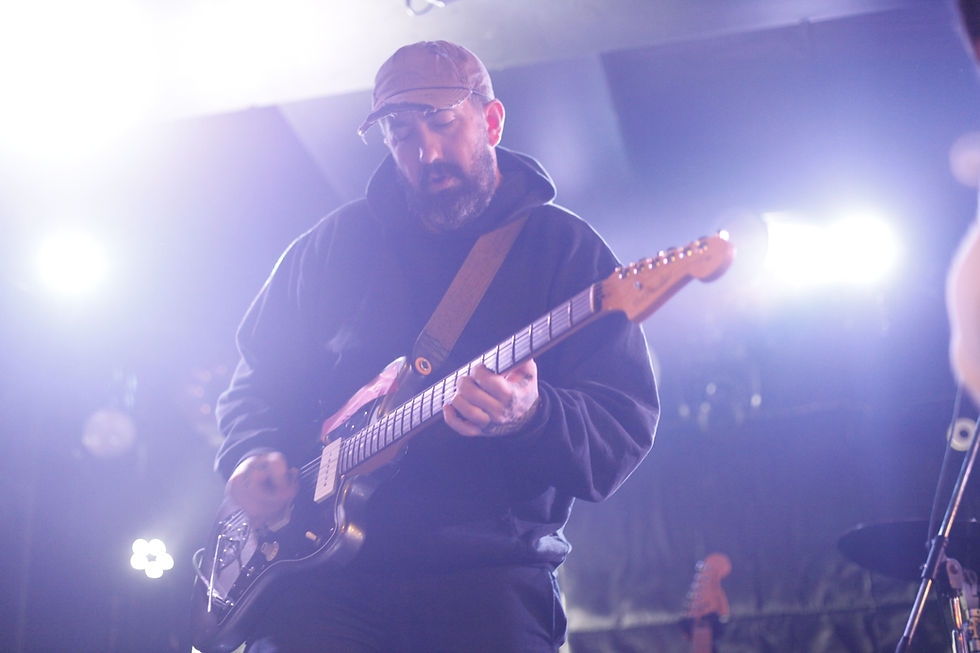
He checks in on everyone, ensuring the energy stays grounded amidst the whirlwind of tour life. Sensing my own apprehension—this being my first interview in 15 years—he leans in with a warm, disarming smile. "We are friends here," he tells me, instantly dissolving the tension. As we settle in, he reflects on the surreal timing of being in Tokyo. Just days prior, he witnessed My Bloody Valentine perform what he described as a "perfect" set—a rare moment of being genuinely nervous to meet an idol, Kevin Shields, amidst a chaotic 24-hour blur of Tokyo nightlife and a literal earthquake. It was a fittingly turbulent backdrop for a record that Palermo describes as his most vulnerable yet.
It was probably the best live show I've ever been to. I wasn't expecting that. I've seen MBV before a few times, in 2008 and then later. Man, it was so good. It was perfect. The best they've ever sounded. I got to meet Kevin afterwards for the first time. It was crazy—a weird and kind of cool moment. When we got to meet him, I was really nervous. I haven't been nervous for somebody in a long time.
I didn't sleep much the night before because we went to my friend's bar, Beat Cafe. We left that bar at 12:00. He closed his own bar so we could go to a different bar, Nightingale, until 2:30. Then we went to my other friend's bar who runs a cosplay strip club thing. I'm not a strip club guy, but it’s kind of fake, with fake money and everything. My friend Rio brings a bottle of Hennessy out at 4:00 in the morning. We drank until 5:30, went home, slept for three hours, went to Disneyland, walked 10 miles, rode rides, and then went right to MBV. I was a mess. Cold sweats, felt like I was dying. So getting ready to meet him, I felt like I was having a heart attack.
He was super cool, super nice. He knew we were coming because we've been talking to management about working with them in the future. They were really kind and took care of us. I told him, "I can't believe how perfect you guys sounded. I have to imagine this is how you envisioned this band sounding 35 years ago." He thought that was really nice, and then we just talked about people he knew and talked shit for 45 minutes.
It was a crazy 24 hours. It ended by me finally going back to bed, and then an earthquake happened. It only lasted for 15 seconds—I've never been in an earthquake before—but I had finally just fallen asleep. I thought, "Well, that was a crazy day." This is very typical of what happens to me.
Let's talk about Slide Away Fest. You’ve mentioned in past interviews that many people doubted you when you first launched it. Now you’ve taken the festival to Tokyo — a major move — and both shows sold out. How did the Tokyo edition come together?
It's strange because I'm not built to be a promoter, but at the same time, I don't think I was ever built to be a musician either. I kind of had the ambition to do it, and I taught myself what I needed to do. I think I was always a pretty good songwriter, but I'm not the greatest musician. I learned pretty early on that I didn't need to give myself limitations, and that I was capable of doing whatever I wanted to do despite the odds.
A big part of it was wanting to try this and see it through. We got it done the first year, and then I realized the only thing I could do is make it bigger. We went from a 1,200 cap room to two bicoastal 3,000 to 4,000 cap rooms. This year we managed to get Hum, who I was trying to get for all three years. We did two New York shows in a 4,000 cap room, two Chicago shows in a 4,000 cap room, and two shows in LA in a 4,000 cap room. It's been a massive turnaround. To me, it was like, why stop there? Now I have the chance. I try to bring in foreign bands because it's hard to get to America to play, and that's where things really pick up for a lot of people. I got a couple of foreign bands in, like Mint Field and Terraplana.
My thought process was that if I could do this here, I could do it anywhere. So we did Mexico City. I was able to lean into the Latin American bands, put a little money in, and hopefully eventually get them over to the US. The same thing went for these Tokyo shows. We didn't have enough of a billing to really dig in because we wanted to bring Whirr with us as well. So we figured we're bringing in two of my favorite bands at least, Yuragi and Envy. The groundwork is laid now. The hard part is out of the way. It's just about trying to build on each market.
Are there plans to bring Slide Away to Europe or the UK in the near future?
That's the plan eventually. We're working on the UK now. We want to get a stronghold in the UK, do something cool there, and then hopefully one European city.
Your new album is set to be released in a few weeks. How did this record come to life?
When we recorded Guilty of Everything and then went into the midst of COVID, I thought maybe that this record would be a good tie-up for the four albums. Having a little bit of extra time at home, getting out of that two-and-a-half-year album cycle, I was just sitting at home thinking too much. I was forced to look inward because I wasn't on this "tour, record, tour, record" cycle. All this weird stuff started to come to light, and that's when I decided I had something to write about.
I started to feel reinvigorated. I had something to say. Soon after I started writing the songs, I realized that a lot of the surface stuff that I was speaking about before may not have been as honest as I could be. I wanted to shed more of the weight off my shoulders. So I threw caution to the wind and was a little bit more honest about myself and things that have happened to me over my whole life. It felt good to feel vulnerable and make myself face the things that I've been hiding.
There’s a song on the album where you’re very open about childhood trauma and abuse — something you’ve kept the door closed on for many years. What made you decide to open up about that now?
I don't know. Just being in that grind for 10 or 12 years... I got a lot off my chest in Guilty of Everything, but then I got sucked into this gauntlet of touring and writing. I feel like I wasn't really getting the right stuff out. I think I used that as an excuse to just make some music and say some things. Not to say there's no substance there, but I wasn't shedding enough of what I really wanted to get to. A lot of that was just tough things to deal with, but also self-consciousness. I’ve hidden behind that. I've hidden behind alcohol. I've hidden behind the music. I've hidden behind tour. Music and art sound best when you're testing yourself and confronting your demons. Having that time on my hands, I was forced to look inward a little bit more than usual. Things started to surface, and when they surface, I just dump them out. That's how I do it.
You’ve been diagnosed with essential tremors, and there are moments on the album where that vulnerability is audible. What made you decide not to conceal it?
Yeah. You can probably hear it when I'm just talking sometimes now; it’s a vibrato. With singing, it starts to shake a little bit. My hands aren't so bad right now, but it gets worse. It's a progressive thing. When I was faced with this time, I saw what these 15 years have done to my mental and physical state. I go hard. I put my head down and run through walls a lot of the time, and it's taking its toll. With all these other revelations I was having, like facing mortality, it just fit well with the theme. Rather than try to hide what I'm dealing with, I embraced it. That's why a lot of the record has really clean vocals with no reverb. Partially because I want to be as honest as possible—what I'm saying is the most honest I've ever been, so I want to present myself honestly too. But I also wanted to test the musical limits of what we do. Usually, you have this recipe for how a Nothing song should sound. I didn't do that this time. I wrote this based on how it felt like it should be. For better or for worse, that's what's in this record.
In a genre like shoegaze that is defined by hiding behind layers, was it terrifying to let the listener hear that?
Yeah. The last time I recorded was 2017. The essential tremors picked up a lot. I put the first song on and sang back, and listening to it, I was like, "Whoa, what is my voice doing?" The ET is working its way into my vocal cords now. At first, I was panicking. I wondered if we should smooth it out in the studio or reverb it out to hide it. A couple of the guys in the band said, "You should embrace it. It's your voice. It’s what is most natural, and what you're saying fits well." I always listen to our demos—just an iPhone voice memo with a guitar—and I suck at singing and I'm bumbling around on the guitar. But those always sound the most endearing to me when I listen back. I wanted to take that energy into this record.
The current lineup has been described online as something of a “supergroup.” How did this particular group of musicians influence your creative process, and what did they help you achieve on this record that may not have been possible before?
This lineup is the best it's ever been in the band for sure. There's just too much talent. Everyone is so good. I knew I wanted to use a lot of electronics, so I pulled Zach into this. He has some really good projects in the scene like Manslaughter 777. Doyle has been with us almost the longest at this point. He’s a super good guitar player—super good at everything, honestly. He’s got this amazing voice that I've never had. Bobb has been around forever. He's the most pro. He's super efficient on bass, which I've never really had. We've had bass players, but nobody who was really a player. Christina learned bass to play in Nothing—she was great, one of my favorite people, same with Aaron—but Bobb is a player. He’s friends with Fiona Apple, you know? Usually, when I write records, I keep the bass very simple. But Bobb swelled in the songs and turned these lists of songs into so much more with his bass parts. Having Cam around has been great too. He's younger, but he's got a great voice and is super good at guitar. He's got his shit together. He is hot. He makes us look better on stage. I feel like he's my little nephew; we've grown up with him.
We were able to unlock a lot of things when we did this record together. I brought these demos to the guys, and everyone leaned into them and put their own imprint on what I had. That's always been what I try to do with Nothing, but it's elevated this time. We're all getting older, better at what we do, and a little more free in how we approach things. I still have the wheel, but I have a good group of four people with me now. Every person that's played in this band has made their imprint. I've carried a bit of each of them with me along the way and I always will. Nothing would never be Nothing without every single person in the band.
You’ve collaborated with Will Yip extensively in the past, but on this record you worked closely with Nick Bassett. You’ve said that no one understands what you’re trying to achieve better than he does. What is it about your creative chemistry with Nick that makes it so intuitive, and what did he specifically bring to the album?
Me and Nick are just locked in always. We identify each other's thoughts. We lived together in Philly for a little while and wrote the Death of Lovers record together. We just know what we want. He's such a good musician. When I can't convey ideas of how I want the song to sound, he knows how to find it. Writing a record with him was something I've been wanting to do forever. It was a great experience working with him and getting him out of his comfort zone. He’s self-conscious about what he does. If we didn't have him to mix this record, it wouldn't sound the way it sounds right now. He was really nervous about it, saying, "That's a big responsibility, hell. I'm pretty scared to do this." We went and got test mixes done from three other producers, and Nick's just sounded the best. That gave us confidence. Me and him went to work for three months, talking on the phone for 10 hours a day. It was a long, hard project, but one of the most special things I've ever been a part of.
There are quite a few stories circulating about your time recording at Sonic Ranch. What was the atmosphere like there, and how did that environment shape the final result?
The place was beautiful. It was in Texas, out in the middle of nowhere on a pecan tree farm, right on the Mexican border. It had the perfect amount of isolation and dried-out, beautiful land. That was great for the process. Getting the guys out there to feel that same isolation while stepping through this record was a bit of an unknown. We had skeletons of these demos, but it was very wide open. It was a really special thing.
Obviously, we're maniacs, right? So if we started drinking at 2:00 p.m.—that's our rule, we can't start earlier than 2:00 p.m.—we get in the studio at 10:00 a.m. By 11:00 p.m. when we stop, it's party time. We were DJing in the big room out in the middle of nowhere, having dance parties. We had some friends come and visit. There was a Mexican Corridos band next door. We hung out with them one night until 5:00 in the morning. I got drinking with the horn section and asked, "You want to play on the record?" They said yes. I didn't know where, but listening back to the songs, I realized the ending of "Never Come Never Morning" needed a horn section piece. So they came in the next day and just rocked it out. It was super natural. It was another magical, cosmic place that fits perfectly with everything else on the record.
A few years ago, you said you didn’t have much faith in humanity, and that Nothing would likely “end in a blaze,” because people like you don’t get peaceful endings. Now that you’ve documented this history of decay, do you still feel that ending coming — or has finishing this “final chapter” actually brought you a sense of peace?
I don't know if I would ever find peace. I am getting a little bit more comfortable with living in my own skin. Bringing out some of that honesty and allowing myself to be vulnerable to my past and trauma is all a part of me recovering in a sense. But at the end of the day, I don't do myself a lot of favors. I still run at high speed all the time. I run until I crash, then pick myself up and run until I crash again. If there's a problem in front of me, I approach it by trying to put my head through it. The shelf life of some of my goals is not good, and I'm at peace knowing that I probably won't have a peaceful end. But I think that's okay.
Philadelphia has become strongly associated with the modern shoegaze scene, and Nothing played a major role in that shift. What do you think it is about Philadelphia that produces such a visceral, emotionally charged sound compared to other scenes?
I just think Philadelphia has a struggle that is in the air. It has a certain energy that is already kind of polluted. It was something I always embraced, and it seeps out of me. I think a lot of these younger bands in Philly have that same thing in them. You can hear it in bands like Knifeplay, TAGABOW, Halloween, Full Body 2. Not all of them have had the same run that I have from Philly, or even came from where I came from. A lot of them moved to Philly and cling to the Philly thing, but you don't have to be there long to start feeling it affect you. I just had to be fortunate to be in there since I was born, under the El train in Kensington where it’s now become super popularized, where people see the videos of everybody down there. But it was like that in the 90s too when I was growing up. It was just heroin then. Now it’s fentanyl and tranq and stuff like that. But in the 90s it was sad like that too. Everyone’s doped out of their minds, the violence that comes with that is out there. So there’s just an energy there. It’s like kind of the same energy that a house has after there’s been a murder inside of it, you know what I mean? That’s the kind of feeling it has there. And you don’t shake that. I think people just carry that energy in the family—it’s there.
Where do you see Nothing heading after this record?
Who knows? Right now, I'm just taking it one day at a time, trying to get through the day. We have a big schedule. I'm doing too much. I worry about if I'm going to crash out at some point. So if I can get through this year without losing a limb or an eye, I think I'll probably take it easy for a while in 2027. Maybe just pop down to LA, do a Slide Away here and there.
I'm not going to do this forever. Even Slide Away has a shelf life. I'd like to do it for a couple more years because I see people love it—there's a whole aura around it. But I don't want to let anybody down. When it's time to stop, I will. Same thing with Nothing: when it's time to stop, I will.


Comments