The Last Pagans of Shoegaze: Fighting Cultural Erasure with a Wall of Sound
- Kamola Atajanova
- Jun 8
- 8 min read

Not everyone knows where the Republic of Mari El is, and what shoegaze has to do with a dying language that is protected by UNESCO. But for the musicians behind the ethno-shoegaze project Lugovye Mari, merging massive walls of guitar feedback with this ancient folklore is a matter of cultural survival. Tucked along the Volga River in central Russia, the republic is the ancestral homeland of the Mari—a Finno-Ugric ethnic group frequently recognized as the last indigenous pagans of Europe. For centuries, they have maintained a deeply rooted animistic belief system where the forests and rivers are alive with spirits. In the rural expanses of the republic, economic pressure and state assimilation are pushing younger generations out of their indigenous villages and into Russian megacities. Today, their UNESCO-recognized endangered language and centuries-old traditions are being swallowed whole by urbanization.
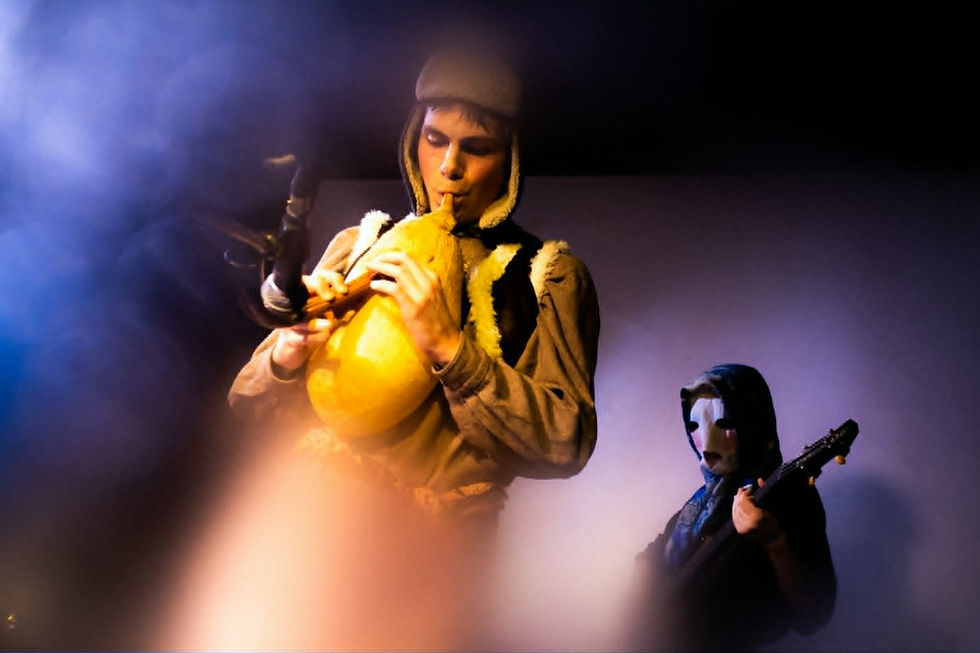
When Innokenty Nesmelov and his bandmates made that exact migration to Moscow, they refused to let the distance sever their roots. Formed in 2019 on the outskirts of Yoshkar-Ola, they set out to reclaim their heritage using an unexpected tool: shoegaze. Dropping heavy guitar rigs into ancient folk traditions might seem contradictory, but Nesmelov insists shoegaze is a perfect fit. Mari culture, he points out, has always been intensely loud. The Shiydarman—a heavy chest ornament worn by Mari women—was explicitly crafted to clash and ring out with every step, generating a localized noise to communicate directly with spirits. "There’s a saying that a Mari person can be seen or heard from afar," Nesmelov explains. In that context, an overdriven amplifier and a massive wall of distortion aren't a disruption of the old ways. They are a modern translation of the ritual.
The band slices the piercing wail of the Shüvyr (a traditional bagpipe) straight through thick layers of guitar drone. Their songs recount cosmic deities and rites of love, all sung in a language that is rapidly fading. It serves as a heavy, deliberate resistance against cultural erasure. “For me, singing in Mari is an opportunity to explore the culture and look inside myself,” Nesmelov says. “We want to create a small 'island' within the city—a place where people can feel like they've come back home.”
I always think that if someone listens to our project and starts digging inside themselves, asking, "Who am I, really?"—that is the highest praise we could receive.
Can you tell us the story of how the band formed?
The band was formed in 2019 in Medvedevo, a small settlement on the outskirts of Yoshkar-Ola, the capital of the Mari El Republic. I started the project as a deep exploration into my own roots, a way to reconnect with a culture my family had lost over time. The lineup has changed over the years, but currently, it’s Yana Maron, Sabina Shalkova, Lada Ismailova, and me, Innokenty (Kesha) Nesmelov.
For those who haven’t heard you yet, how would you describe the sound of Mari to someone in Europe or the US?
We play ethno-shoegaze (ethnogaze)—sometimes I hope we’re the pioneers of this genre! There's also a bit of ambient in there. Lately, we've started adding traditional instruments to our live performances, like the Mari bagpipe (Shüvyr) and small organic flutes (Olym Shüvyr), which literally translates to "straw bagpipe." Sometimes we also use various drone pipes and the Tümür, a traditional Mari drum. Unfortunately, these aren't on our recordings yet, but we try to experiment during live shows so that the typical guitar sound just becomes part of the background. Beyond music, we also engage in various artistic projects: creating art objects, doing performances, putting together mixes of traditional Mari music, and sharing the culture through essays and short videos.
Singing in a language recognized by UNESCO as endangered is a powerful choice. Was it a conscious decision to use music as a form of preservation, or did it simply feel more natural to express yourselves emotionally in Mari?
I’m actually not a native speaker. My roots go back to the Nizhny Novgorod region, home to the rarest group of Mari—the North-Western Mari. They have their own dialect (yötnömäl-käsvel mare yïlmï), which is so rare that its speakers can sometimes speak it but don't know how to write it, because it isn't taught anywhere. For me, singing in Mari is an opportunity to explore the culture and look inside myself. I wanted to see if we could express feelings in a language that isn't native to our daily lives, but is native to our souls, allowing us to learn more about our roots and traditions.
Right now, the decline of the Meadow Mari language—which is the literary standard for all Mari groups and the one we sing in—is a severe issue. It is mostly spoken by the older generation and people in rural villages. As younger people move to the cities, the language is slowly disappearing. So, if we can help preserve it and motivate even a few people to study their native language, that would be a huge joy for us!
What does it feel like to be one of the only shoegaze bands in your region? Is there a local scene that supports you, or do you feel like outsiders in your own home?
In Mari El, we always feel right at home, entirely thanks to the audience and our friends. We actually don't live in the region anymore—we all work in Moscow—so we travel to Yoshkar-Ola to perform as guests. But every time, we are welcomed as if we never left. Even though we’re the only shoegaze band in the Republic, there are several cool indie projects in Yoshkar-Ola, like "dom nomer semnadtsat" (House Number Seventeen), "gladit lam" (Petting Llamas), and "sooosad." However, they aren't ethno-oriented.
In the ethno-music scene, our great friends in the band U EN (which translates to "New Person" in Meadow Mari) are doing incredible things. They are very well known locally and do a lot for the development of music in the region, playing ethno-rave with traditional Mari instruments. They always help us organize gigs and record live sessions. We even recorded a demo with them in Meadow Mari that I hope will turn into a full-fledged release someday.
How do the nature and landscapes there influence the atmosphere of your music?
Mari traditional beliefs and culture have been one of the biggest revelations of my life and a massive source of inspiration. When it comes to our music and lyrics, 99% of it is dedicated to Mari culture, even when the song is performed in Russian. For example, the song "Shyzhe" (Autumn) is an interpretation of a poem by the outstanding Mari poet Sergei Chavain. "Yöratem" is a ritual song about love; it tells the story of a girl sitting in a boat on the Vyatka River, where a couple must drink from a maple ladle to prove their feelings. "Ola" is about a young man who misses his relatives and spontaneously decides to visit them after coming to the city to buy a sled. "Pokto vele, korno say" translates to "Oh, drive on, the road is good!", based on verses by Mari poet Maxim Yemelyanov. It’s a blessing for a bright future and a celebration of life—it feels like rushing on horseback through a winter forest with a close friend, completely unstoppable.
Even our Russian-language songs, like "Lesa" (Forests) and "Lugovye Mari" (Meadow Mari), are full of cultural references. You'll hear phrases like "Mother in the heavens," referring to the goddess Shochyn-Ava, or "The forest is our walls," representing the animistic belief that spirits are everywhere and favor those who respect nature. We also sing about the sun giving life to everything, as Keche (the sun) is one of the most important symbols in our culture.
And, of course, there’s the live track "Shüvyr," which features the bagpipe. Through the clash of melody and harsh noise, we depict the duality of the world's creation—the cosmic confrontation between Yumo and Keremet, the two supreme Mari deities who, in the form of drakes, raised silt from the bottom of the world ocean to create life.
Do you feel a certain responsibility or pressure as one of the few contemporary voices keeping the language alive through a modern genre like shoegaze?
Honestly, we do feel a great responsibility when interpreting Mari culture through this genre. Interestingly, traditional Mari music is already quite "noisy." There’s a saying that "a Mari person can be seen or heard from afar." Even the traditional women's chest jewelry, the Shiydarman, was designed to emit vibrations and noise so women could communicate with spirits just by walking or doing everyday chores. Because of this, shoegaze felt like the perfect, accessible modern form to express these specific emotions in connection with our heritage.

That said, Mari culture is very protective and intolerant of distortion. It is only by staying faithful to tradition that the Mari people have preserved their culture over centuries—they are often called "the last pagans in Europe" for keeping things exactly as they were. Because of this, modern innovations like heavy guitar music are sometimes accepted reluctantly, and there are conflicting opinions within the Mari community about what we do. But we always emphasize that we create this music out of deep love and respect for our people and traditions.
When you write, do melodies come first, or do you begin with the rhythm and phonetics of the Mari language? Does the language itself shape the way you play your instruments?
Sometimes, an idea or lyrics for a song are born during our trips around the Republic. In those moments of inspiration, almost any melody can naturally fit the text. But more often than not, the music comes first. Music is a universal way to communicate with the listener, and some of our songs don't have any vocals at all. However, the Mari language definitely shapes the rhythmic and melodic components of a track. It sits in the mix completely differently than Russian does. It has unique, drawn-out vowels, and people often tell us it sounds a lot like Japanese when they first hear it.
In many parts of the world, native languages were historically pushed aside in favor of more “international” ones. Does performing shoegaze in Mari feel like an act of reclaiming identity in a globalized world?
I think it really does feel that way. There is intense urbanization happening in the country, which drives many people to assimilate and fulfill themselves within the dominant, state-forming culture (Russian). It’s a natural and understandable process given the economic realities in the regions. I grew up in a village myself, but now I live in the city to work and support my family. Because of this displacement, we want to create a small "island" within the city—a place where people can feel like they've come back home through our music. More broadly, I just want as many people as possible to know about the Mari culture. As long as our name is spoken, it means our people still exist.
What do you hope someone from a completely different culture takes away from your music, even if they don’t understand the lyrics?
I always think that if someone listens to our project and starts digging inside themselves, asking, "Who am I, really?"—that is the highest praise we could receive. For example, in our country, there is a huge population of people who are ethnically Finno-Ugric—whether they are Mari, Udmurt, Komi, Erzya, Moksha, Khanty, Mansi, and so on. Our main goal is to awaken people's interest in their own culture and roots, and to show how beautiful and unique that heritage can be. Different peoples and cultures are the colors of the world; without those colors, what would become of us?
Could you share one Mari word that has no direct translation in English but perfectly captures the mood of your music?
I would choose the word Tünya (Тӱня), which is the title of our debut release. This word carries a huge number of meanings—it's almost like a symbol. It means the universe itself, the cosmos, world space, global peace, balance, and all that exists. If you add the word Osh (white) to it, it means "the white world" or "the light." It's a word you have to process through your feelings and your heart, rather than your logical mind. Once you do that, you enter the Mari Tünya.
If someone were to listen to just one song from your discography, which one would you choose—and why?
I would choose "Yöratem."
It's a ritual song, and in the chorus, we sing "I love you" in Mari. I believe that love is always right and that it moves the world. If you want to listen to one of our Russian-language tracks, you should definitely check out "Ya doma" (I am home). It captures a very specific, fleeting feeling that comes after a long separation from your native land. It’s a very personal story!


Comments