Resplandor on Working With Robin Guthrie of Cocteau Twins, Making Classical Shoegaze, and Finding Inspiration in the Ocean

Updated: May 11
In the mid '90s, Antonio Zelada spent long hours digging through a record store in Lima, Peru, chasing sounds that felt raw, dreamlike, and a little out of step with everything around him. He was buying Slowdive EPs, listening obsessively, and slowly shaping the idea that would become Resplandor. Antonio put out an ad for a drummer, the first lineup came together, fell apart after an early show, and kept going anyway — because the songs were still there, and so was the vision behind them.
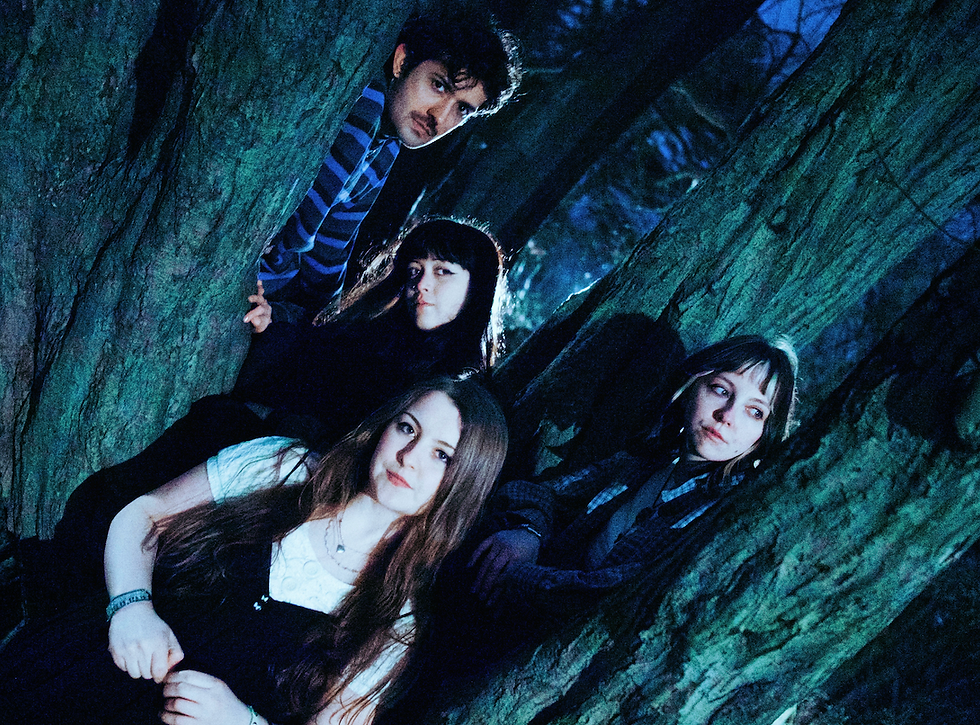
From there, Resplandor's story only grew. The band went on to work with Robin Guthrie of Cocteau Twins, and they shared stages with some of shoegaze and rock music's defining names, including Slowdive, The Cure, and The Jesus and Mary Chain. After Antonio moved to the Netherlands, the project kept evolving, eventually becoming a trio with Minne Davids on drums and Jomie Bagchus on vocals and synths. On a late April night, I saw them live in a small club in Zurich and I was completely blown away by the set — the kind of music that does what the best shoegaze always does, making you forget the world around you.

That night, we sat down together for an interview to discuss the band's origins, their influences, the move from Peru to the Netherlands, and Robin Guthrie's sonic imprint on their records.
Can you tell us the story of how Resplandor first came together as a band?
Antonio: The band started many years ago. I felt like I needed to express certain things, and I was spending a lot of time in a record store in Lima, where the band first took shape. They had incredible records there, and I bought my first EPs — especially Slowdive EPs — while spending hours listening, learning, and discovering new bands.
So I put up an ad in the shop looking for a drummer. One guy called me, and we decided to start playing together. We had a few friends join us for jams, and that was really the beginning. But after our first show, things fell apart, as they often do with bands, and we split up.
I decided to keep the project going, though, because the songs were mine. From there, I moved toward the kind of approach I'd been inspired by in Cocteau Twins — strong lyrical imagery, drum machines, sequencers. It felt right. A friend joined later, and we remained a duo for a long time before a drummer eventually came back into the band about ten years later.
Jomie and Minne, both of you are relatively new to the band — how did each of you come on board?
Jomie: I joined after Minne sent me a text saying Antonio was looking for a new vocalist. I was already playing in two shoegaze bands, so I thought it would be great to join Resplandor. I started coming to rehearsals, then went on tour, and really enjoyed it. It was a great experience, and my first show with Resplandor was in Leipzig at Wave-Gotik-Treffen, which was really special. That’s how I ended up in the band.
Minne: For me, it was about two years ago. I was already playing in another shoegaze band, and a friend of mine who also plays in a shoegaze band knew Antonio and invited him to see us perform. I think that was at V11 — he saw us play with Thrilled for the first time. A couple of months later we played another show, Antonio was there again, and after the set he asked if I wanted to join Resplandor as the drummer.
Do you remember the first time you heard shoegaze and realized you wanted to make music in this genre?
Antonio: It was back in the '90s. I still remember seeing My Bloody Valentine perform "Only Shallow" on 120 Minutes, that old MTV show that actually had great music programming. It completely blew my mind around 1991 or so. Then, when I saw them at their first reunion in London in 2008, everything just clicked into place. It was amazing.
Minne Davids: I was studying music at school in a fairly broad program, so we covered everything from production to instruments like drums and piano, and we also had to form bands. My friends were already into shoegaze, but I wasn't really aware of it yet. At the time, I was more into alternative rock like Radiohead and heavier stuff like Alice in Chains. Then my friends said they wanted to start a shoegaze project, and I was like, "What is that?" I genuinely thought I had never heard it before, but when they played me a few songs — "Only Shallow" and some Slowdive tracks like "When the Sun Hits" — I realized I already knew the sound. I just didn't know what it was called. We started the project as a school thing, and from there I kept getting deeper into the genre and liking it more and more.
Jomie Bagchus: For me, it was quite similar. I was also at music school, and one of my producers recommended a few shoegaze songs and walked me through the genre. I started with Slowdive, listening through their records back to back. That's when I realized I'd already been listening to shoegaze all along — I just didn't know the name for it. That was about four years ago, and since then, during another school project, some friends wanted to make shoegaze and asked me to sing. That was really the start of it for me.

Which bands, except My Bloody Valentine, were the biggest inspirations when Resplandor was first taking shape?
Antonio: Definitely Slowdive and Cocteau Twins. When I recorded the first EP, Sol de Hiel, and the first Resplandor album, Elipse, I was more focused on using reverb and delay to build atmosphere rather than distortion. That was a big inspiration for me.
It was always a dream to later work with Robin Guthrie from Cocteau Twins, to play with Slowdive, and to collaborate with Simon Scott, the drummer from Slowdive.
You've supported legends like The Cure, Slowdive, and The Jesus and Mary Chain. What was that experience like, and how did those opportunities come about?
Antonio: I'm proud to say that Robert Smith himself picked the band. The promoter called me and made it clear he didn't want to take any credit — it was Robert Smith who wanted us to open the show. The second time, it was the same story.
It was incredible because Robert Smith is such a great person. He came backstage with a bottle of champagne and told us to enjoy the show. We have some really great photos with him because he’s genuinely wonderful. The second time was just as memorable — he was very kind and really happy to have our records, Tristeza and Pleamar.
It was the same with Slowdive. And with The Jesus and Mary Chain, they already knew the band. That show was especially memorable because we were presenting Pleamar, and Robin Guthrie joined us as a guest guitarist. Since he and the members of The Jesus and Mary Chain are Scottish, they hadn’t seen each other in a long time. It was one of those moments where you could really feel the reunion in the room — just, “Hey, Robin,” like old friends catching up after years apart.
Your 2008 album was produced and mixed entirely by Robin Guthrie. How did that collaboration come about?
Antonio: He played in Lima in 2007, and we opened for him, so he heard the band and liked what we were doing. I asked him if he'd be interested in producing and mixing the album, and he said yes. He came over a few months later, in September 2007, and we recorded the album with him. It was a huge experience, and we learned a lot from him. We worked with him again later on our latest album, Tristeza, although that was during the pandemic, so the process was completely different. He lives in France now, so we did everything online.
What did he bring sonically to these albums?
Antonio: He brought a huge amount of experience, and it was amazing to work with someone who practically invented dream pop and shoegaze. He’s a genius when it comes to layering sounds — that kind of expansive shoegaze approach that creates a massive wall of sound.
The band originally formed in Peru and then later relocated to the Netherlands. How has that geography shaped the band's identity?
Antonio: I think there are a lot of connections between the two places. I was talking about this with Minne, because if you look at Resplandor's lyrics and song titles, the ocean is often a central image.
I grew up facing the Pacific Ocean, and when I moved to the Netherlands, I found the Atlantic and the North Sea. But it's not just the water that feels similar — there's also the fog, the misty days, the gray weather. You can find that in Lima too, and I've always loved that. It's a big source of inspiration for me.
Jomie, how did you adapt to singing in a band whose songs were not originally written in English?
Jomie: For me, it was sometimes challenging. But it was also really interesting to work with a language I don't speak and see what I could bring to it vocally without overpowering the lyrics that were already there. That was the main thing for me.
Minne: Shoegaze has really spread everywhere now, and I feel like it connects on so many levels that the main difference is just the language. But that also makes it more interesting and fun to play.
Antonio: Yes, and now we also have more lyrics in English. The last two albums are mostly in English, though I still have a couple of songs in Spanish. Jomie is doing a great job with that, and we're also working with non-lexical vocals. That gives us that classic shoegaze feel — long songs built on loops — and it works really well.
What keeps shoegaze exciting for you after all these years?
Antonio: For me, shoegaze has never really followed a formula, which is exactly why it still feels alive. There's always something new to build, and there's always a source of inspiration — melancholy, personal experience, even the ocean, which has always meant a lot to me. It's music that keeps generating new sounds.
It's not just a trend or something that's suddenly exploded in popularity. For me, shoegaze is part of life. I started doing it a long time ago, and I've kept going because I genuinely love it.
When we split up in the past, it was partly because people around me were talking about being avant-garde or chasing what was current. But for me, that was never the point. I wanted to make shoegaze then, and I still want to make shoegaze now. I'm not interested in changing that. Of course I love other music too — post-punk, electronic music — but shoegaze is still what inspires me most.
As the genre gets bigger, where do you think shoegaze is headed? In the U.S., it seems to be getting heavier and drifting toward grungegaze — how do you feel about that?
Minne: I love it, to be honest. I really value the foundation of shoegaze — My Bloody Valentine, Slowdive, Ride, all the bands that laid the groundwork — but what I enjoy most is that the genre can blend with so many different styles and still work. I'm especially into bands like Nothing and Trauma Ray as well as Whirr.
Jomie: I like it too. I've been listening to a lot of newer shoegaze, and I really enjoy when bands bring in electronic textures and more synths, because I'm into electronic music as well. That's what I love about shoegaze: you can mix it with almost anything, and it still feels right.
Are there any newer shoegaze artists you've been especially excited about lately?
Jomie: Since we're both in other shoegaze bands, I'd love to mention those too. Minne plays in Thrilled, and I play in Crashing and Part Garden. In the Netherlands, there's a small shoegaze scene starting to take shape, and that's really exciting. More and more bands are finding their own way into the genre, and it's become possible to put together shoegaze nights and build a real community around it. There are also bands like Attic Ocean in Germany, who I really like. They lean a little more pop, but still sit comfortably within shoegaze. I think it's great when a scene starts to form around new interpretations of the genre.
Antonio: I also run a record label and promoter company called Automatic Music, focused on shoegaze and related genres. We have some great bands on the label, like Blankenberge and Life on Venus from Russia, and Mumrunner from Finland. I also love Part Garden and Thrilled — we play together a lot, so it really feels like a community.
I’m also running a shoegaze-focused festival, which is exciting because it brings new bands to Amsterdam and the Netherlands. We’ve had groups like Mahogany from the US, Healees from France, Attic Ocean from Germany, Bloom Effect from Canada, and Catch the Breeze from Denmark, just to name a few. We’ve done six editions so far, with a lot of amazing bands.
Minne: One band I really like is They Are Gutting a Body of Water. Some of their songs are very shoegaze, though not all of them. What I love is how eclectic and strange their discography is — it takes shoegaze and folds it into all these other ideas too.
If someone is discovering Resplandor for the first time in 2026, which song would you point them to as the best introduction—and why?
Antonio: I'd say that when I make an album, I see it as a journey — a complete experience — so ideally, I'd recommend listening to the whole record. Tristeza was built with that idea in mind. The way the songs are placed, from the opener to the second track and beyond, is part of the experience.
But if I had to choose just one song, I'd probably say "Océano," because it has all the elements I mentioned: atmosphere, loops, non-lexical vocals, and that old-school shoegaze feeling. "Reverie" also captures that well, while "Blue" brings in a stronger post-punk influence, which I love too.
Minne: I'd personally go with "Tristeza." I think Resplandor has a few different sides, and while "Reverie" and "Océano" are more loop-based and hypnotic, "Tristeza" feels more progressive. The parts flow together really well. It still sounds unmistakably like Resplandor — the vocals, the guitars — but it also keeps you hooked.
Jomie: I'd probably choose "Blue." I like that it has non-lexical vocals but also includes lyrics. It gets straight to the point, while still keeping that dreamy, flowing feel.


Comments